Online Stores
Shopify vs WooCommerce for a UAE Online Store: Which Is Better in 2026?
Shopify is faster to launch and easier to run for most UAE stores. WooCommerce wins on control, Arabic SEO content and no platform fee. How to choose.
By Kazim Noorani, Managing Director
For most businesses selling online in the UAE, Shopify is the better starting point: it launches faster, needs almost no technical upkeep, and works with the payment, buy now pay later and delivery options UAE shoppers expect. WooCommerce is the better choice when you want full control of your store and data, publish a lot of Arabic and English content for SEO, or want to avoid a monthly platform fee.
The right answer depends on four things: how you take payments, how much Arabic content you need, how complex your catalog is, and who will maintain the store after launch.
How do payments work in the UAE on each platform?
Payments are the biggest practical difference. Shopify Payments, Shopify's built-in payment service, has been rolling out in the UAE in stages: first for Shopify Plus, then for the Advanced plan in August 2026. Stores on the Basic and Grow plans connect a third-party gateway instead. Check Shopify's current rules and fees for your plan before you decide, because they are changing.
WooCommerce has no built-in payment service, so every store connects a gateway through a plugin. Most UAE gateways and card processors offer a WooCommerce plugin, and you pay only the gateway's fees, with no extra platform fee on top.
- Cards and Apple Pay: available on both platforms through Shopify Payments (where eligible) or a local gateway
- Buy now, pay later: Tabby and Tamara both offer Shopify apps and WooCommerce plugins
- Cash on delivery: many UAE shoppers still choose it, and both platforms support it as a payment option
- Currency: both show prices and check out in AED
Which handles Arabic and English better?
Both can run a bilingual store. Shopify supports multiple languages through its translation tools and apps, and many themes support right-to-left layouts, but check RTL support before you buy a theme, because some break in Arabic. WooCommerce uses a multilingual plugin, which gives you more control over Arabic URLs and SEO content, at the cost of more setup and maintenance.
If organic search in Arabic is central to your plan, with category guides, blog posts and many landing pages, WooCommerce gives you more room. If your store is mostly product pages with short descriptions, Shopify is simpler.
What about VAT?
UAE VAT is 5%. Both platforms can show prices including VAT and add your TRN to invoices. Set this up before launch, together with your refund and delivery policies, so every order is correct from day one.
Which costs less to run?
Shopify charges a monthly plan, plus apps for features it does not include. Hosting, security and updates are included. WooCommerce is free software, but you pay for good hosting, premium plugins, security and regular updates, and someone has to do that work.
For a small or mid-sized UAE store the total yearly cost is often similar. The real difference is effort: Shopify takes almost no technical upkeep, while WooCommerce needs ongoing care. If you do not have a developer on call, Shopify is usually the safer choice.
Which suits B2B and large catalogs?
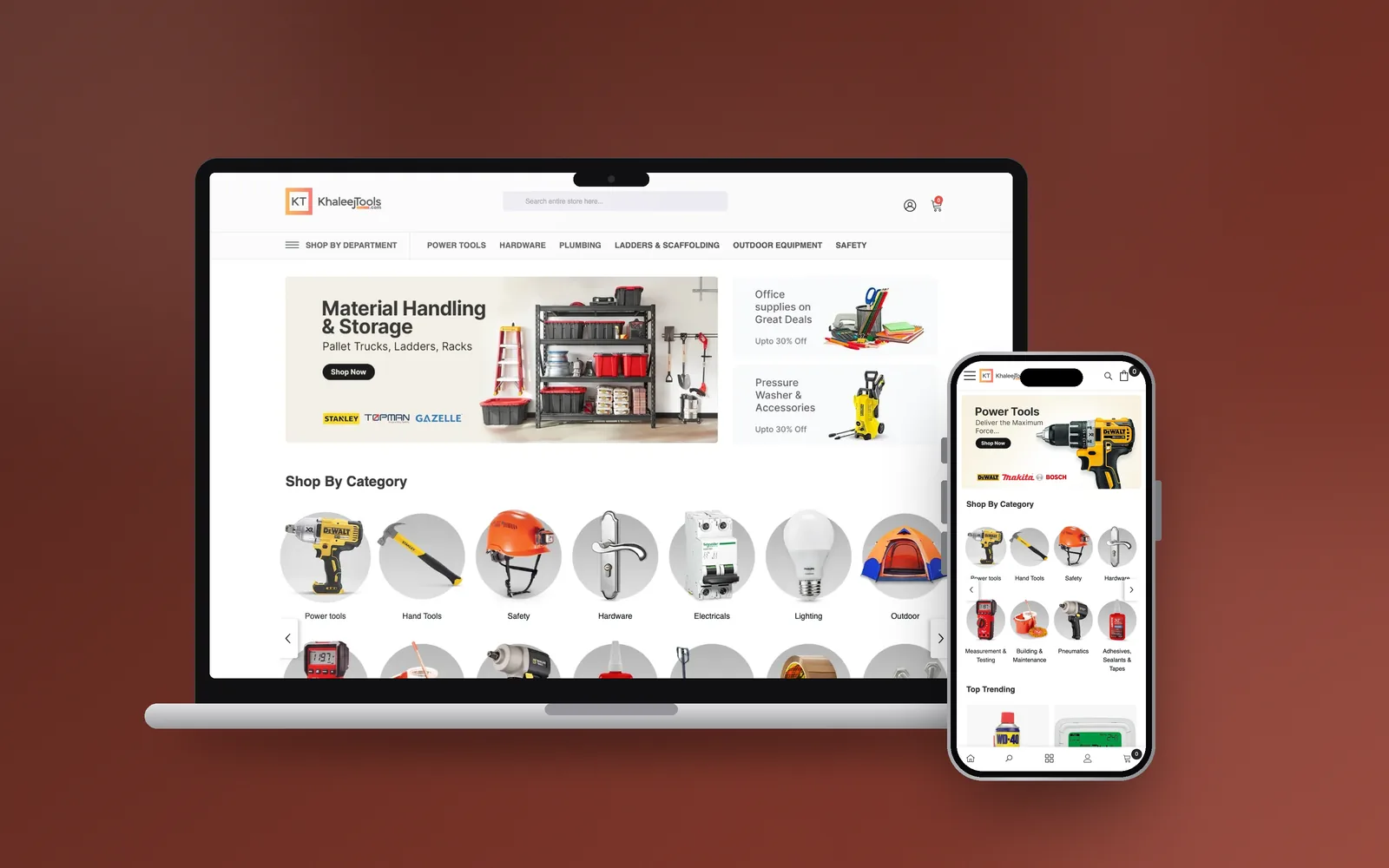
We built the Shopify store for Khaleej Tools in Dubai, which sells industrial supplies, power tools, building materials, ladders and scaffolding. The store runs on a custom Shopify theme in AED, organized so trade buyers can browse by category and find products quickly, with wholesale pricing and clear delivery information for bulk orders.
That shows Shopify can handle a large B2B-style catalog well. Stores with very custom pricing rules, quote requests or deep links to an ERP may still be better on WooCommerce or a custom build. The full Khaleej Tools case study is on our Works page.
So which should you choose?
- Choose Shopify if you want to launch in weeks, have no developer on call, and sell mainly through product pages
- Choose WooCommerce if you already run WordPress, publish a lot of Arabic and English content, or need full control of data and checkout
- Consider a custom build only if your buying flow is unusual, such as quote-led B2B or a marketplace
Our Shopify stores start from USD 3,000 and our WooCommerce stores are quoted after a short call, because plugins and hosting vary. Either way, the store, domain and data should be in your company's name.
Frequently asked questions
Is Shopify Payments available in the UAE?
It has been rolling out in stages: first for Shopify Plus, then for the Advanced plan in August 2026. Stores on other plans connect a third-party UAE payment gateway. Check Shopify's current rules for your plan.
Can I offer Tabby or Tamara on Shopify and WooCommerce?
Yes. Both Tabby and Tamara offer a Shopify app and a WooCommerce plugin.
Can a Shopify store be in Arabic?
Yes. Shopify supports multiple languages, and many themes support right-to-left layouts. Check that your theme handles Arabic properly before you buy it.
Is WooCommerce cheaper than Shopify in the UAE?
WooCommerce has no monthly platform fee, but hosting, plugins and maintenance cost money and time. For most small and mid-sized UAE stores the yearly total is similar.
How much does a Shopify store cost to build in the UAE?
Our Shopify builds start from USD 3,000 for a theme-based store with AED pricing, payments, VAT and delivery set up. Custom designs and integrations are quoted after a short call.
Related Services
Have a project this connects to? We’d like to hear about it.
Talk to Us→